
After arriving in Louisiana in May 1743 as an officer in the French Marines (cadet à l’aiguillette) and serving under Governor Vaudreuil in New Orleans for eight years, Jean Baptiste Lapaise de Védrines was in the Pays des Illinois by July 1751, where he was commissioned as an Enseigne en second the following year. Seven years after serving at Fort Chartres, in the fall of 1758, Jean Baptiste Lapaise de Védrines was making preparations to marry Elisabeth de Moncharvaux, the daughter of his Captain, Jean Baptiste François Tisserand De Moncharvaux. As an Officer, he had to get permission from Commandant Macarty[1], which he apparently did because Macarty was also one of the witnesses of his marriage, which took place on October 10, 1758, at the chapel of Sainte Anne de Fort Chartres. Because Elisabeth de Moncharvaux carried her father’s French name, her maternal heritage is not immediately recognizable. However, her maternal ancestry most likely stretched back in the New World for centuries. Her maternal great grandmother was Marie Rouensa “Aramepinchone” (1677-1725), a full-blooded Native American of the Illinois Kaskaskia Tribe. So, whereas Jean Baptiste Lapaise de Védrines arrived in Louisiana from France, the young woman he married fifteen years afterward was, in many ways, a native of the New World.
Elisabeth was born on April 22, 1744 at the Arkansas Fort along the Mississippi River at the mouth of the Arkansas River during the time her father, Jean Baptiste François Tisserand De Moncharvaux, was serving as Commandant of the Fort (from 1739-1748) and baptized there on July 10. She moved to Fort Chartres, Illinois when her father was reassigned there, and was about seven years old when Jean Baptiste Lapaise de Védrines arrived in the Pays des Illinois.
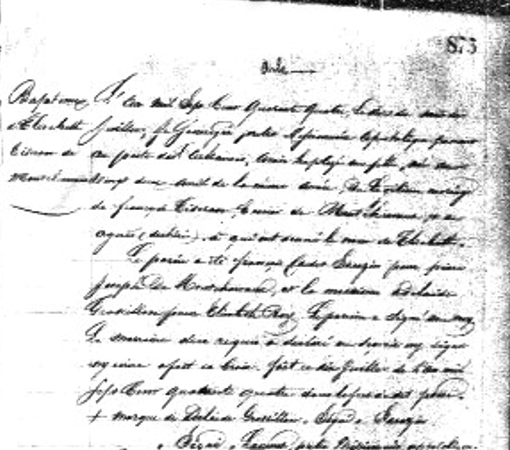
Baptism Record of Elisabeth de Moncharvaux
In Louisiana, Elisabeth de Moncharvaux is often called an “Indian Princess” among Vidrine descendants when, in actual fact, she wasn’t quite so. It is true that she was part Native American, having descended from Marie Rouensa. Belonging to one of the most well known families in Kaskaskia for both the French and the Kaskaskia communities gave her stature. The Princess part probably comes from that as well as the fact that she was so young when she married Jean Baptiste Lapaise de Védrines at the age of 14 while he was 46. Her father, who was the Captain of a detached company alongside Jean Baptiste Lapaise de Védrines’, had most likely encouraged the marriage. While we do not know it with certainty, perhaps he encouraged the marriage because he knew the virtue and goodness of his fellow officer, Jean Baptiste Lapaise de Védrines, and wanted his daughter to have a good husband such as him.
Jean Baptiste François Tisserand DeMoncharvaux, the father of Elisabeth de Moncharvaux, was born on February 26, 1696 and baptized the same day in the Parish of St. Pierre, Diocese of Langres, in northeast France, known as the Champagne region. After serving in the French Marines in Flanders and Canada, he was sent to serve in Louisiana, arriving in New Orleans on March 4, 1731.
He was first given command at the Post of Pointe Coupée, Louisiana in 1731. (Interestingly, this is where his daughter, Elisabeth de Moncharvaux and her husband, Jean Baptiste Lapaise de Védrines would first settle after the French lost the War in 1763.)
The next year, in 1732, he was promoted to Enseigne en second and sent to Illinois in Upper Louisiana (Illinois) and put in charge of a small fort just erected at Cahokia. At some point, he met Marie-Agnès Chassin (granddaughter of Marie Rouensa) and married her on February 11, 1737 at Kaskaskia, Illinois. (His first wife, Marie-Louise de Vienne and three sons had died in a shipwreck on the way to meet him from Canada to Illinois).
From 1739-1748, he served as Commandant of the Arkansas Post near the mouth of the Arkansas River, where his daughter Elisabeth de Moncharvaux was born.[2] In 1748, he was appointed Captain.
He was given command of the royal convoys up the Mississippi River from New Orleans, Louisiana to the Illinois country in 1748 and 1749, during which he was accused of spending too much money and abusing alcohol but was later defended by Governor Vaudreuil.[3]
In late 1751, he was commanding at the Kaskaskia Fort, where he was again in 1756, in command of a Company of 24 men.[4]
By 1757, he was stationed on the Missouri River along with his son, Jean Baptiste de Moncharvaux, Jr. and four other soliders.[5] (It was during this time that one of his Officers, Jean Baptiste Lapaise de Vedrines, married his daughter, Elisabeth De Moncharvaux on October 10, 1758 at the chapel of St. Anne de Fort Chartres, Illinois.)
After the French loss the War in 1763, he returned to France.[6] (This was the same year that his daughter Elisabeth de Moncharvaux and her husband, Jean Baptiste Lapaise de Védrines were preparing to move to Lower Louisiana at the Pointe Coupee Post.)
In a letter from his home in Lousiana to his family in France dated May 6, 1815, Dr. Francis Robin made a curious comment about Jean Baptiste François Tisserand De Moncharvaux having had an “estate which consists of, among other things, a chateau located about half a league from Boulogne-Sur-Mer.”[7] This could be part of the inheritance he tried to regain by taking his brother to court. But, sadly, after having lived a life of faithful and tremendous military service in Louisiana with all the glory such a life brings, he returned to France and had to end his life “in a state of despair, of total ruin, and plunged into desolation.”[8]
Jean Baptiste François Tisserand De Moncharvaux died four years after returning to France, on June 14, 1767 at the Hotel Dieu (Hospital), Paris. (One interesting fact is that this is the oldest hospital in Paris, founded by the Bishop, St. Landry in 651.[9] The same year De Moncharvaux died at the Hotel Dieu, his daughter and son-in-law and their children were living at the Opelousas Post in Louisiana, which just a few years later would be known as St. Landry Parish.)
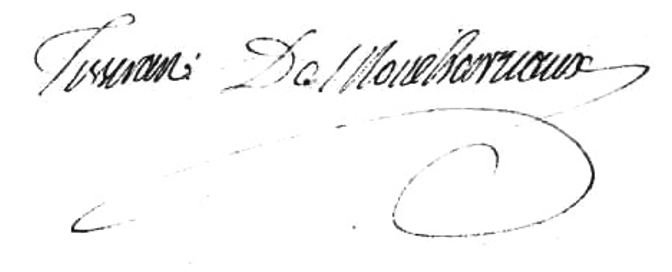
Signature of Jean Baptiste Francois Tisserand de Moncharvaux
Unfortunately the children of Jean Baptiste Lapaise and Elisabeth de Védrines were never able to meet neither their maternal or paternal grandparents.
Elisabeth’s mother was Marie Agnes Chaisson, who was the daughter of Agnes Philippe. And Agnes was the daughter of Marie Rouensa “Aramepinchone” (1677-1725), a full-blooded Native American of the Illinois Kaskaskia tribe.
Marie Rouensa’s father was Chief Francois Xavier Mamentouensa Rouensa (1650-1725), who at one time served as Chief of the entire Illini Confederation.
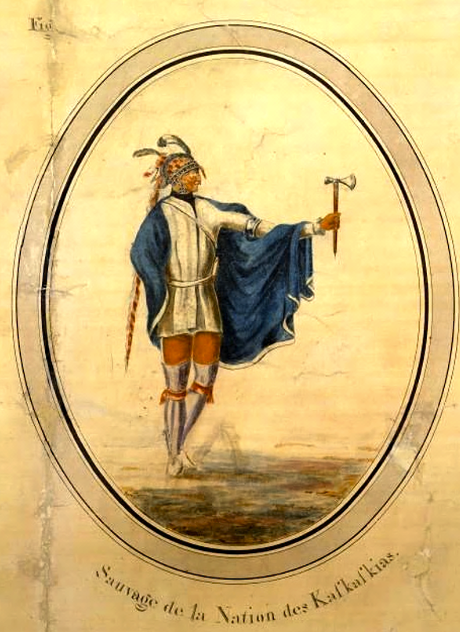
Member of the Kaskaskian Indian tribe, Vignette from map. G. Bois St. Lys and J.J. Boudier, “Carte généraledu cours de la rivière de l’Ohio…le tout desiné sur les lieux par Joseph Warrin…pour server à l’intelligence des voyages du général Collot dans l’année 1796.”Bibliothèque nationale de France, département Cartes et plans, CPL GE A 664.
Marie converted to Christianity shortly after the Jesuit Priests arrived in Illinois in the late 17th century and became an influential woman in their missionary work and in the village of Kaskaskia, Illinois. Her life was so significant that Duke University included her in their seminars on women who helped to shape the nation in 1999. Moreover, Ohio University teaches a history course based on her life, and the Illinois State Museum has an entire wing dedicated to Marie and her tribe.
The Jesuit Father Jacques Gravier, SJ described Marie’s conversion to Christianity at Peoria, Illinois probably in 1694, when she was 17 years old: “The girl made her First Communion on the feast of the Assumption of Our Lady [August 15]; she had prepared herself for it during more than three months – with such fervor, that she seemed fully penetrated by that great mystery.”[11]
Fr. Gravier’s letters also described with great enthusiasm Marie Rouensa’s prominent public role as a catechist. She became an important assistant who translated the teachings of the Christian faith into the language of the Illini Indians. Fr. Gravier says:
This young woman who is only 17 years old, has so well remembered what I have said about each picture of the Old and New Testament that she explains each one singly, without trouble and without confusion, as well as I could do – and even more intelligently, in their manner. In fact, I allowed her to take away each picture after I had explained it in public, to refresh her memory in private. But she frequently repeated to me, on the spot, all that I has said about each picture; and not only did she explain them at home to her husband, to her father, to her mother, and to all the girls who went there, as she continues to do, speaking of nothing but the pictures or the catechism, but she also explained the pictures on the whole of the Old Testament to the old and the young men whom her father assembled in his dwelling.[12]
She was an instructor for the adults and children of her village of Kaskaskia and an interpreter who was recognized as a gifted storyteller. Even the elders came to hear her. Because of her generous and important help, Fr. Gravier was able to go about doing his daily round of devotional duties while Marie drew new converts to his mission.
Some of her most important converts where her parents, Chief Rouensa and his wife. Devotion to the Roman Catholic faith as it was instilled in her by French Jesuit priests seems to have been a central element in Marie’s life from the time of her conversion in 1694 to the moment of her death. She continued to help the Jesuits in their work throughout her life, and when she died on June 25, 1725, she was buried beneath the floor in the parish church, the only woman in the history of Kaskaskia to be given that honor. Her burial record states that at the time of her death at Kaskaskia in 1725, she was “about forty-five years old.” Her eight children ranged in age from 4 years old to 28 years old.
Unfortunately, as a result of continuous wars with their northern neighbors, in particular the Sac and Fox Tribes, by the time of the Revolutionary War, the Confederation of Illini Native Americans had lost of most of its former territories and greatly decreased in number. The Illinois historian David MacDonald writes:
By the second half of the eighteeth century, the population of the Kaskaskia and the other Illinois tribes had declined precipitously owing to European diseases, alcohol, and intertribal warfare. Contemporary estimates vary wildly, but it is apparent that the Illinois then numbered in the hundreds rather than the thousands.[13]
In the fall of 1803, the Kaskaskia ceded all of their remaining lands in Illinois to the United States in return for protection and patronage. By the time of the War of 1812, most of the Kaskaskia moved west of the Mississippi to Missouri and Arkansas where they maintained their close relationship with the Peoria. In 1854, the Kaskaskia, Peoria, Piankeshaw and Wea Indians united into a single tribe or confederation called the Peoria Tribe of Indians of Oklahoma. The Tribal Headquarters are located in Miami, Oklahoma.[14]
On a visit to the Tribal headquarters of the Peoria Indians in Miami, Oklahoma in December 2016, Fr. Jason Vidrine learned about one of the contemporary Chiefs of the Peoria Tribe with Kaskaskia heritage named Louis Myers. Unfortunately, he passed away in 1994. Residents said that he was the last one at the headquarters who knew a great bit about the history of the Kaskaskia Tribe. Unfortunately, no more living descendants of the Kaskaskia Tribe are known except for the ones with mixed heritage like us who descend from Marie Rouensa.
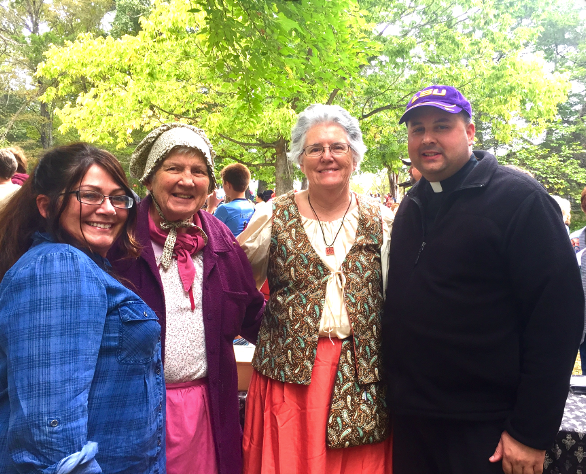
When Fr. Jason Vidrine and Mardell Sibley visited the Pays des Illinois in October 2016, they were able to attend the annual Fête de l’Automne near Old Mines, Missouri. There, they found a publication of the descendants of Marie Rouensa on the genealogy table.[15] It includes the genealogy branches up to Marie Rouensa’s granddaughter, Marie Agnès Chassin, the mother of Elisabeth de Moncharvaux, but does not include Elisabeth and her family – the entire Vidrine Family! They visited with the book’s author, Mary Catherine Norbut and her sister, fellow descendants of Marie Rouensa and have since sent her the genealogical information of our branch of the Rouensa descendants.
[1] HMLO 325, Hunington Memorial Library, San Marino, CA; Theodore Calvin Pease, Illinois on the Eve of the Seven Years War, 1747-1755 (Springfield, IL, 1940), p.306.
[2] Cf. Roger E. Coleman, The Arkansas Post Story (Santa Fe, NM, 2009).
[3] Archives Nationales Coloniales, C13 A35, f. 112.
[4] Archives Nationales Coloniales, D2, C51, f.24-28.
[5] Ibid.
[6] Cf. Robert Bruce Ardoin, Recueil de divers documents historiques et genealogiques relatifs aux families Vedrines et Tisserand, Puteaux, (France, 1981), p.24.
[7] David Lanclos, The letters of Dr. Franc̦ois Robin 1784-1826, (Pecaniere, LA, 2009), p. 29.
[8] Robert Bruce Ardoin, Recueil de divers documents historiques et généalogiques relatifs aux familles Vedrines et Tisserand, Puteaux, (Paris, 1981), p.24.
[9] For more about the life of De Moncharvaux, Cf. Dictionary of Canadian Biography: www.biographi.ca/en/bio/tisserant_de_moncharvaux_jean_baptiste_francois_3E.html
[10] J. F. Snyder, “The Kaskaskia Indians: A Tentative Hypothesis”, Journal of the Illinois State Historical Society (1908-1984), Vol. 5, No. 2 (Jul., 1912), p.236.
[11] Reuben Gold Thwaites, ed., The Jesuit Relations and Allied Documents: Travels and Explorations of the Jesuit Missionaries in New France, 1610-1791 (Cleveland, OH, 1896-1901) LXIV, pp.211-15.
[12] Ibid.
[13] David MacDonald and Raine Waters, Kaskaskia: the Lost Capital of Illinois (Carbondale, IL, 2019), pp.41-42.
[14] Cf. http://peoriatribe.com/history/kaskaskia-tribe
[15] Cf. Mary Catherine Norbut, Descendents of Chief Francois Xavier Rouensa, Old Mines Historical Soceity, Inc (Old Mines, MO, 2007). Second Edition.