
When the Roman Army moved into eastern Gaul (France), into today’s region of Auvergne, they encountered Vercingetorix, Chieftain of the Gallic tribe of the Averni, who led a remarkable rebellion against the rule of the Romans. Like many others, he was eventually crushed by Julius Caesar and the mighty Roman Army in 46 BC.
The famous Gallic Wars were a struggle for the Romans which took a great amount of time, but ended up being profitable for them, especially Caesar who had found himself bankrupt in 63 BC. This profit came, in large part, from the acquiring and selling of slaves – an evil that was a very lucrative source of income even in the ancient world. Slaves were readily available – and in great numbers – after the Roman wars of conquests, from prisoners-of-war and even from the ranks of ordinary tribal members. Caesar himself claimed that he had sold around 53,000 members of the Gallic Aduatuci tribe (including men, women and children) after a particular incident in which they had pretended to surrender, but instead attacked the Romans in 57 BC.[1]
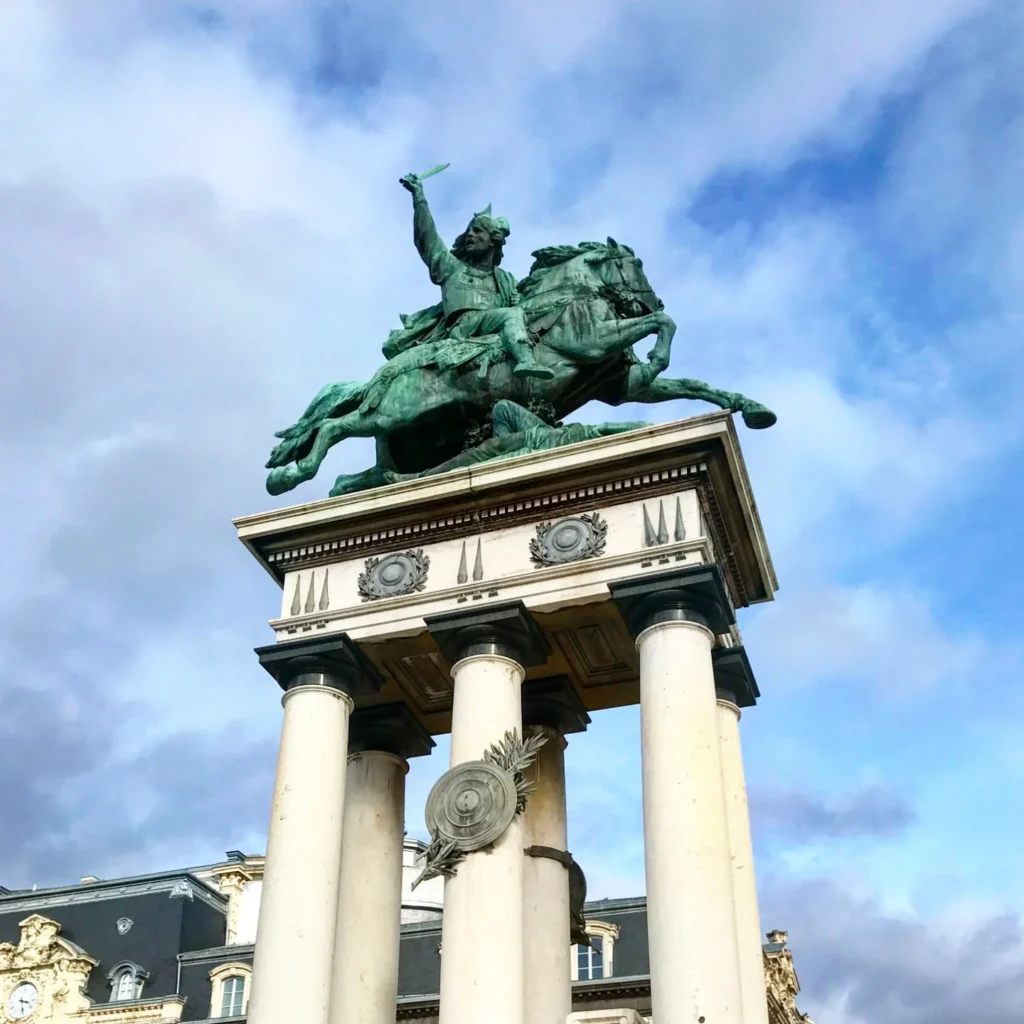
Statue of Vercingetorix by Auguste Bartholdi, Place de Jaude, Clermont-Ferrand, Auvergne, France. Photo by Fr. Jason Vidrine
The biggest threat for Caesar came in 52 BC when a coalition of tribes in central Gaul under Vercingetorix (chieftain of the Averni tribe) rose against the Romans. Caesar finally besieged Vercingetorix at Alesia with a force of 60,000 men. Famine eventually overcame the fighters while Caesar’s troops defeated a Gallic rear attack. According to Caesar himself, the number of those killed by his conquering forces in the hard-won sieges and battles were more than 10,000, which included – abhorrently – many women and children. Vercingetorix was brought to Rome in chains, exhibited in Caesar’s triumphal march, and executed in prison six years later. Serious resistance from the tribes of Gaul had now ended, but minor uprisings caused Caesar considerable frustration during 51 BC.[2]
Once he had conquered the Arverni, Caesar spent the year 50 BC trying to win the goodwill of Gaul. He formed it into a new Roman province named Gallia Narbonensis, which was referred to so often simply as the Provincia that a part of the ancient region is still known today as Provence. After his victories, Caesar usually rewarded faithful Roman Legionaries with property in the newly-acquired territory, while also leaving the local elites of Gaul in power with no new burdens imposed on them. He gave rewards to chieftains and honors to various tribes, and ceased taking booty from a country, which was worn out by the struggle of these terrible years.[3]
Under the Roman Empire, the Averni tribe was peaceful and prosperous. Their capital was moved to the new Roman city of Augustonemetum (present-day Clermont-Ferrand). Its population was estimated at 15,000-30,000 in the 2nd century AD, making it one of the largest cities in Gaul under the Roman Empire. Its name was changed to Arvernisin in the 3rd century (taking its name, like other Gallic cities in this era, from the people who lived within its walls), and grew until the mid 3rd century.[4]
Around this same time, according to St. Gregory of Tours (538-593), a native of Arvernis, which today is Clermont-Ferrand, Pope Fabian sent out seven Bishops from Rome to Gaul to preach the Gospel around the year 250 AD: St. Gatianus (Gatien) to Tours, St. Trophimus (Trophime) to Arles, St. Paul to Narbonne, St. Saturninus (Saturnin) to Toulouse, St. Denis to Paris, St. Martial to Limoges, and St. Austremonius (Austromoine) to Clermont.[5] The latter is called the “Apostle of Auvergne” and is considered the first Bishop of Clermont. Because of his tireless work, the region of Auvergne was already imbued with the Christian Faith by the 4th century.
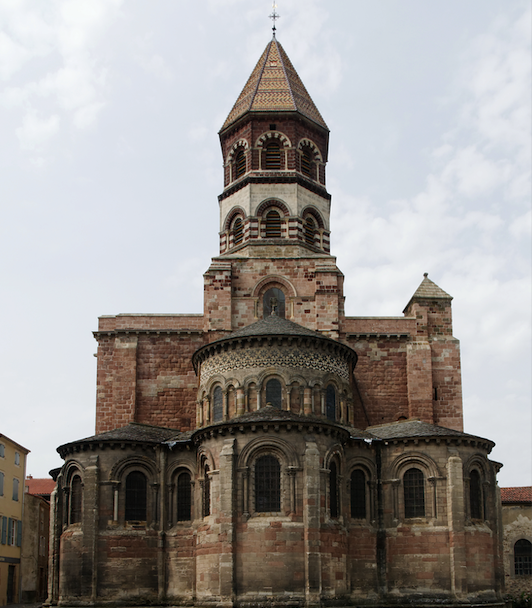
Basilica of Sainte-Julien in Brioude, Auverge, France. Photo by Fr. Jason Vidrine
Brioude is another former Roman settlement of Auvergne about an hour south of the Roman city of Augustonemetum (Clermont). There, in 304 AD, St. Julien, a former Roman Legionary who had converted to the Catholic Faith was martyred. After being beheaded by pagans, he was buried at Brioude and over his tomb, a church was erected. The church was expanded in the 11th and 12th centuries and became the Basilica of Saint-Julien in Brioude. This massive colorful Basilica attracted a multitude of pilgrims in the Middle Ages and is the largest Romanesque Basilica in Auvergne today.[6] It’s within a few miles of Brioude that several ancient small communities named Védrines are found.
In summary, it is likely that the name Védrines is derived from one who was an immunis in the Roman Army, a Roman Legionary known as a Veterinus, dedicated to the care of war/draft animals in the supply train. Serving in the Roman Army as such, this Roman Legionary went into Gaul under Ceasar and as a faithful soldier was rewarded and installed in the new Roman Province of Avernis after Vercingetorix (and the Averni) were conquered. Settled in this ancient region, which would later be named Auvergne, the name Veterin(us) became Vederine or Védrines by the Middle Ages.
The Duel
On July 2, 1932, the Ville Platte Gazette first published the story of the Duel, which supposedly brought the first Vidrine to Louisiana.[7] Though the newspaper column contained more specific details, the basic kernel of the story is:
“A long time ago, a Vidrine lived in France. There was a duel, une affaire d’amour. The nobleman Vidrine killed another nobleman. Duels were forbidden; that’s why Vidrine had to leave his homeland. He crossed the ocean to America and settled in Louisiana.”
Over 20 years later, in 1956, the editor of the Gazette, Jules Ashlock (who himself descended from the Vidrine Family), repeated the story of “The Duel” to Jacky Vidrine and asked her to find the truth about it.[8] Thankfully, we have learned so much since then. We know with certainty thanks to the work of Jacky Vidrine and others that the Duel repeated in Vidrine Family history was not historically accurate, at least as far as the Vidrine Family’s arrival in Louisiana. But it is also repeated by the De Védrines family at Monflaquin, France as the reason they arrived in the region of Agen from the ancient region of the Auvergne in the Midi before the end of the 1500’s. So apparently the tale of the Duel was repeated by the settlers of the Vidrine Family in Louisiana (Jean Baptiste Lapaise de Védrines and his two sons who were born in the Louisiana territory) but, as often happens, it was eventually changed by their descendants to refer to them, as the repeated tale shows. As Jacky wrote: “Even though some of the details have been proved false, the very continuity of the heart of the story across an ocean and through three centuries demands attention.”[9]
[1] Dattatreya Mandal, “Gallic Wars: History, Armies, and Tactics”, 24 Sept 2019, https://www.realmofhistory.com/2019/09/24/15-facts-gallic-wars-part-I.
[2] “When France was Gaul: The Era of the Roman Empire”, https://www.discoverfrance.net/France/History/Roman_Empire.shtml
[3] Ada Russell, “Julius Caesar: Roman Institutions and Empire”, https://www.heritage-history.com/index.php?c=read&author=russell&book=caesar&readAll=true
[4] “Arverni”, Encyclopaedia Britannica, https://www.britannica.com/topic/Arverni
[5] St. Gregory of Tours, Historia Francorum, i.30, https://sourcebooks.fordham.edu/basis/gregory-hist.asp#book3.
[6] Cf. https://www.catholique-lepuy.fr/prier-et-celebrer/saints-du-diocese/28-aout-saint-julien-de-brioude
[7] “The Tale of Those Pioneers Who Settled Ville Platte 130 Years Agone”, The Weekly Gazette, (Ville Platte, LA), 2 Jul 1932, pp 1 and 6, www.newspapers.com/image/474297842
[8] Jacqueline Olivier Vidrine, Védrines-Vidrine: Our Védrines in France 1600-1750, (Lafayette, LA, 1981), p. 143
[9] Jacqueline Olivier Vidrine, Védrines-Vidrine: Our Védrines in France 1600-1750, (Lafayette, LA, 1981), p. 144.