
When the English defeated the French, bringing the French and Indian War to a conclusion, the Treaty of Paris was signed in September 1763, granting all land east of the Mississippi (which included the Pays des Illinois) to England. Most of the French inhabitants were unwilling to continue living among those who spoke a different language and practiced a very different faith and way of life and whom they had fought against for years. Selling their possessions, they left the Illinois Country. Many moved to the west of the Mississippi River, to Sainte Genevieve or to the newly created city of St. Louis, Missouri. Others moved south toward Natchez, Missippi or New Orleans, Louisiana, both of which were now under the rule of the Spanish…and much more accomodating for those who were Catholic and spoke French like Jean Baptiste and his family. The young Védrines family had their second child and first daughter, Agnes Vidrine, in 1763, either as they prepared to leave the Illinois Country for New Orleans, or on the way there.
Newly retired from active service in the French Marines, Jean Baptiste and his wife, Elisabeth and their family probably spent anywhere from a few months to a year in New Orleans as many did at the time.[3] They then decided to move 120 miles up the Mississippi River from New Orleans to the Post of Pointe Coupée, where Elisabeth’s father, Jean-Baptiste Tisserand de Moncharvaux had briefly served as Commandant when he first arrived in Louisiana back in March 1731.
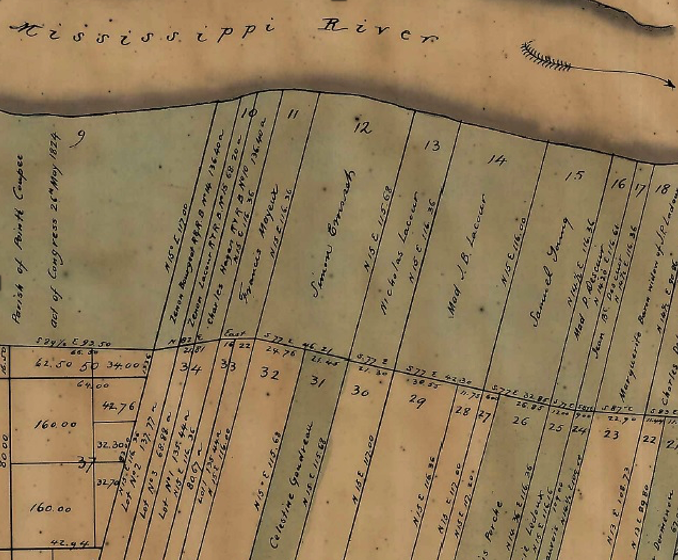
Detail of early map of Pointe Coupée
Pointe Coupée – French for “cut-off point” – is one of the oldest French communities in Louisiana after the founding of New Orleans. It received its name from the brothers Iberville and Bienville in their March 1699 exploration of the lower Mississippi. The first settlers arrived in the early 1720s, among them, Decoux, Decuir, and Pourciau from the Hainaut region of Belgium and France. The French Governor of the Louisiana colony saw the importance of the point and soon installed a garrison there under a Commandant and had a fort built. This became Le Post de La Pointe Coupée.
By 1722, the Capuchin Friars from France began to minister to the people of Pointe Coupée. One of the first four Capuchin Friars to come from France, Fr. Philibert de Viauden, O.F.M. Cap.’s was the first Priest to visit the new post. From 1722 to 1724, his missionary ministry included visiting all the posts along the Mississippi River from New Orleans to Pointe Coupée. In 1726, Fr. Raphaël de Luxembourg, O.F.M. Cap., Superior of the Capuchins in Louisiana, visited the post of Pointe Coupée and wanted to have a church building built there with a resident Priest. Colonial officials approved, but it would be more than ten years before it happened. Meanwhile, Holy Mass was offered and the other Sacraments were administered when Priests stopped to rest at the post during their voyages up or down the river, such as Capuchin Fr. Irénée, O.F.M. Cap., in 1735 and Jesuit Father Pierre Vitry, SJ.
When the post at Natchez was abandoned farther upriver after the massacre there in 1729, Pointe Coupée became the leading tobacco-producing area in the colony. Settlers at the post included French who had come from France and French Creoles as well as Africans from the French West Indies (Guadeloupe, Martinique and Saint-Domingue).
In 1738, Capuchin Fr. Anselm de Langrès O.F.M. Cap., was appointed Pastor of Pointe Coupée. The first church was finally erected and was dedicated on March 16, 1738. It was given the name St. François d’Assise (St. Francis of Assisi).
By 1745, the population of Pointe Coupée consisted of 260 whites, 426 blacks, 23 Indians, and 15 mulattoes. Slaves belonged to 75 percent of the district’s sixty-one households, which included a garrison and a church. Half of all slaves at Pointe Coupée inhabited only eight farms, with twenty or more slaves, but the average number of slaves per farm was nine.[4] After 1750, Pointe Coupée also became a major herding area for the lively cattle trade between Spanish Texas and the Mississippi Valley.
Like Jean Baptiste Lapaise de Védrines, many former French soldiers from Fort Chartres, Illinois as well as Fort Toulouse, Alabama moved to Pointe Coupée in the 1760’s. By 1769, the population had grown to 783 individuals and then to 1,521 individuals by 1785.[5]
Because of the Mississippi River’s change of course, the church at Pointe Coupée had to be rebuilt in 1760 while Fr Irénée, O.F.M. Cap., was Pastor, and was dedicated on the Feast of St. Francis that year. It stood next to the Fort of Pointe Coupée. A cemetery was blessed in 1764. This is the church that Jean Baptiste Lapaise de Védrines and his family attended while they lived at Pointe Coupée.
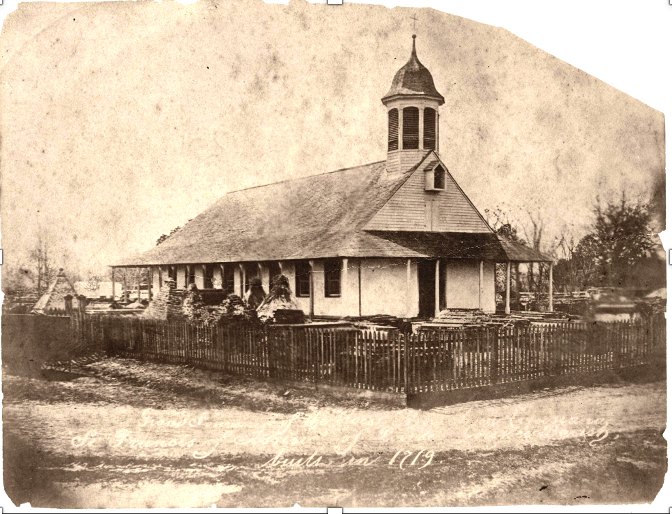
The (Second) Church of St. Francis, Pointe Coupée, LA, from an old photograph, ca. 1890
This second church stood for 130 years opposite Bayou Sara, serving not only the local community, but countless others who passed on the great river. It was once part of the Diocese of Quebec, Santiago, Havana, Louisiana and the Floridas, Baltimore, and New Orleans. Its zealous French and Spanish missionaries also ministered to the faithful up and down and across the Mississippi River. It was the mother church in this area. During the Civil War, it suffered desecration. Afterwards, it came to be less used as the community relocated away from this part of the river due to the series of devastating floods. The ever-eroding river bank was to be the cause of its abandonment, and it was dismantled in 1891. Its location and the surrounding cemetery have been lost to the river.[6]
Leaving New Orleans for the Pays des Illinois in the convoy with Commandant Macarty on August 20, 1751 (the same year Jean Baptiste Lapaise de Védrines went to Fort de Chartres), one French Marine, Jean Benard Bossu wrote this:
Going up the river, we came to “la pointe coupée.” This post is situated about and hundred and twenty miles from New Orleans. The ground there is most fertile, and is covered with fruit trees. The place is mainly colonized by the French, who busy themselves with the culture of tobacco, cotton, rice, maize, and such other commodities. These colonists are also engaged in the cutting of timber and wood, which they transport to New Orleans as rafts.[7]
Jean Baptiste Lapaise de Védrines and his family lived at Pointe Coupée for about eight years, from 1765-1773. During this time, Jean Baptiste Lepaise de Védrines and Elisabeth de Moncharvaux had three children.
Shortly after arriving at Pointe Coupée, their third daughter, Perrine Vidrine (1765-1808) was born on August 03, 1765 and baptized soon after on August 20, 1765 at St. Francis Church by Fr Irénée, O.F.M. Cap.[8]
A few weeks following Perrine’s baptism, on September 2, 1765, Jean Baptiste Lapaise de Védrines traveled to New Orleans to grant Power of Attorney to Pierre Boré, merchant of New Orleans. It’s one of the only records known that he signed Jean Lapeze Vedrine.[9]
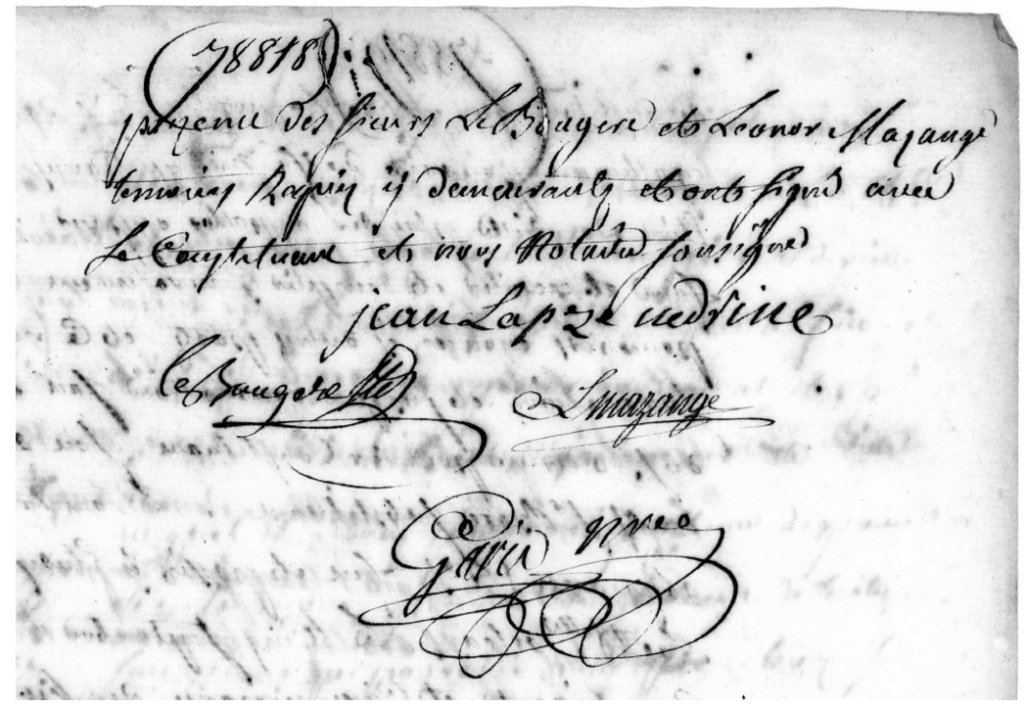
Power of Attorney to Pierre Boré, BB#96, #9094, (78816-19), Judicial Records of the French Superior Council, Courtesty of the Louisiana State Museum and the Louisiana Historical Society, New Orleans, LA
The Spanish Census of Pointe Coupée taken on April 25, 1766 shows Jean Baptiste Lapaise de Védrines residing on 4 arpents (about 3.4 acres) of land with his wife and four children: one boy [who was Jean Baptiste Pierre Vidrine (age 4)] and three girls [who were Marie Jeanne (age 6), Agnes (age 3), and Perrine (age 1)]. Also listed with the family is one slave.[10]
On September 19, 1767, a Bond of Jean Baptiste Lappeze [de Védrines] in favor of Jean Baptiste Gardes was signed.[11] That same day, the marriage contract between Demoiselle [Marie Anne] DeMoncharvaux (younger sister of Elisabeth) and Pierre Clermont was signed. Apparently, they traveled to the courthouse together.
On that same day – September 19, 1767 – the fourth daughter of Jean Baptiste and Elisabeth, Marie Anne Vidrine (1767-1768), was born. She was baptized on July 17, 1768 by Fr Irénée, O.F.M. Cap.[12] The note in the register says: “Supplied Ceremonies for Baptism previously preformed at home” which means that she was baptized in the state of an emergency at home by either Elisabeth or Jean Baptiste when she born. She was most likely born with some type of disease or sickness. Tragically, she died a month later on August 12, 1768 and was buried there in the cemetery at the Pointe Coupée Post by Fr Irénée, O.F.M. Cap.
Marie Anne’s tragic death is reflected in the Spanish Census of Pointe Coupée taken the next year, in 1769, which again lists Jean Baptiste Lapaise de Védrines with his wife and four children: one boy (who was Jean Baptiste Pierre Vidrine) and three girls (who were Marie Jeanne, Agnes, and Perrine).[13]
However, the next year, the Védrines family would welcome their second son, Etienne Vidrine dit Lapaise (1770-1849) who was born on June 15, 1770. He was the first true native son of South Louisiana in the Vidrine family, as his older brother was born in Illinois. Two months after his birth, Etienne was baptized on August 5, 1770 at St. Francis Church by Fr. Irénée, O.F.M. Cap.[14]
It is thought that Jean Baptiste Lapaise de Védrines homesteaded some property at the Opelousas Post (near Washington, Louisiana) as early as 1769. Perhaps it was a vacherie or farm similar to what his family in France had at Lapeze.[15] We know that he registered a cattle brand in the Opelousas District in 1770. One thing is clear though: if he did have land at the Opelousas Post that early, it was only a farm and was in addition to his property in Pointe Coupée because on December 4, 1772, Jean Baptiste Lapaise de Védrines’ land at Pointe Coupée is mentioned as being next to the tract of land of Antoine Goudeau, which was sold to Simon LeMoyne.[16]
But by the middle of the next year – May 1773 – Jean Baptiste received a grant of land at the Opelousas Post from the Spanish Government, which he bought from Philippe Duplechin.[17] So eight years after arriving at Pointe Coupée, he departed, moving his family west to the Opelousas Post…leaving no trace of the Védrines-Vidrine family there (as at New Orleans) except for the information about them in the civil and ecclesiastical records.
The life that Jean Baptiste Lapaise de Védrines and his family had departed was captured by a traveller who visited Pointe Coupée over fifteen years later in 1791:
“Here is now a very respectable village, defended by a strong fortress and garrison of Spaniards, the commander being the governor of the district…The French here are able, ingenious and industrious planters: they live easy and plentifully, and are far more regular and commendable in the enjoyment of their earnings than their neighbors the English: their dress of their own manufactures, well wrought and neatly made up, yet not extravagant or foppish; manners and conversation easy, moral and entertaining.”[18]
[1] Kaskaskia Manuscripts 63:5:10:1.
[2] Archives Nationales Coloniales, D2 C59, f32.
[3] Cf. David Lanclos, The letters of Dr. Franc̦ois Robin 1784-1826 (Pecaniere, LA, 2009), p.36.
[4] Cf. “Pointe Coupee” at http://www.acadiansingray.com
[5] Cf. Historic Sketch, St. Ann Parish, Morganza, La. Diamond Jubilee, 1872 to 1947, http://files.usgwarchives.net/la/pointecoupee/churches/ptcpost.txt
[6] History of St. Francis Church, https://www.stmarysfr.org/65
[7] Jean Bernard Bossu, Travels through that part of North America formerly called Louisiana, 1751-1762, (Norman OK, 1962) p.198.
[8] Pointe Coupee Records: PCP 1, 238.
[9] BB#96, #9094, (78816-19). Louisiana State Museum and the Louisiana Historical Society, New Orleans, LA.
[10] Spanish Census of 1766, General Archives of the Indies, National Archives of Spain, https://www.sos.mo.gov/default.aspx?PageID=9621
[11] Pointe Coupée Documents, 1762-1803: A Calendar of Civil Records for the Province of Louisiana, Winston Deville (Ville Platte, LA, 1997), p.6.
[12] Pointe Coupee Records: PCP-4, p.29.
[13] Legajo 128, folios 848-850, Papeles Procedentes de Cuba, microfilm, LSU Libraries Special Collections, Hill Memorial Library, Baton Rouge, LA; Le Raconteur, Vol XXXV, No. 2, June 2015.
[14] Pointe Coupee Records: PCP 2, part 2, p.97.
[15] Cf. Jacqueline Olivier Vidrine, Védrines-Vidrine: Our Védrines in France 1600-1750, (Lafayette, LA, 1981), p.7; pp.29-36.
[16] Laverne Thomas, III, Pointe Coupee Families in Colonial LA 1771-1782, Baton Rouge, LA, 2009), #531, p.29.
[17] Winston Deville, Pointe Coupee Documents, 1762-1803: A Calendar of Civil Records for the Province of Louisiana (Ville Platte, LA, 1997), p.100 (Apendix).
[18] William Bartram, Travels Through North and South Carolina, Georgia, East and West Florida, The Cherokee Country, The Extensive Territories of the Muscogulges, or Creek Confederacy, and The Country of the Chactaws (London, 1791), p.275.