
Jean Baptiste Lapaise de Védrines had several siblings who died in infancy. We know that he had two older brothers who survived to adulthood: Pierre de Védrines (1707-1773) and François de Védrines (1709-1756) as well as one younger brother, Guillaume de Védrines (1716-1788)
Jean Baptiste Lapaise de Védrines’ oldest brother, Pierre de Védrines (1707-1773), who remained in France, married Marie Pinsan (1714-1807), who was from nearby Preignac. When his parents died, he inherited the home at Sainte-Livrade, the farm at Lapeze, and the Chateau Doisy-Védrines. More about his children follows further below.
As Jacky Vidrine’s research first discovered, two of the other brothers of Jean Baptiste Lapaise de Védrines who remained in France became Benedictine Monks. One was his older brother, François de Védrines and the other was his younger brother, Guillaume de Védrines.
The Parish Church of the De Védrines in Sainte-Livrade at the time was also the church of a Benedictine Abbey, which was founded in the 1200’s. No doubt François and Guillaume were influenced by the Benedictine Monks at the Abbey of Sainte-Livrade. Unfortunately, the Abbey there, like the Ursuline Convent, was mostly destroyed during the French Revolution and its contents sold by the Revolutionary Government.[1] A small part of the former abbey buildings remains next to the Church of Sainte-Livrade.
François de Védrines (1709-1756)
François de Védrines, a middle child of Jean Baptiste de Védrines (1679-1746) and Marie De Raymond (1684-1763), was born on December 13, 1709 in Sainte-Livrade. He was baptized the following day in the Church of Sainte-Livrade with his maternal aunt, Isabeau de Védrines (1665–1717) and her husband Bernard Jacoubet de Nombel (1658–1739) as his godparents. He professed vows as a Benedictine Monk sometime after 1735, around the age of 26 at the Mother Abbey of their province, Notre Dame de la Durade in Toulouse, France. Unfortunately, the details of his life are scant, as the records of his Benedictine life are unknown. We know that Fr. François de Védrines died on October 8, 1756 at the age of 46 at St. Martin Abbey in Villemagne, France.[2] (That same year, Jean Baptiste Lapaise de Védrines was serving as an Officer of the French Marines at the Fort de Chartres in Illinois.)
Guillaume de Védrines (1716–1788)
Jean Baptiste Lapaise de Védrines’ younger brother, Guillaume de Védrines, entered the Benedictines before his older brother, François did likewise. Guillaume was born on May 1, 1716 at Sainte-Livrade, the youngest child of Jean Baptiste de Védrines and Marie de Raymond. He was baptized a few months later, on September 3, 1716 at the Church of Sainte-Livrade with his paternal aunt, Anne de Védrines (1672-) and paternal uncle, Guillaume Reyre (1670-1724) serving as his godparents. Guillaume entered the Religious Life at the age of 19, professing vows as a Benedictine Monk on September 23, 1735 at the Abbey of Notre Dame de la Durade in Toulouse, about eight years before Jean Baptiste Lapaise joined the French Marines and departed France for the Louisiana Territory.[3]
About ten years later, Fr. Guillaume appears as a Benedictine Monk at the Abbey of Mas Grenier (southern France) in 1744, the year after Jean Baptiste Lapaise went to Louisiana.[4] At some time later, he was transferred to the Abbey of Sainte-Croix in Bordeaux, where he was elected Sub-Prior (third in command of the Abbey) on February 11, 1767.[5]
On November 3, 1783, Fr. Guillaume de Védrines was listed as a senior Monk of the Abbey of Ste. Croix (indicating authority in the Abbey). He gathered in Chapter with the Prior and other senior Monks to make a decision about whether or not the Monks of the Abbey would offer the Mass for the deceased at the cemetery of the parishioners that year. We don’t know the particular reasons, but they decided that they would not. Surely there were some parishioners who were not very happy about this decision.
This is the text of the record:
“The third of November seventeen hundred eighty-five, after finishing Prime (Liturgy of the Hours), R.P. Dom (the Rev Fr.) François Antoine Bonnefoy, Prior of the Abbey of Sainte-Croix assembled in Chapter in the usual manner of the Religious of the said Abbey, explained to them that the Chapter had conceded to the Parishioners of Ste. Croix, from the present city land, sufficient land to serve as a cemetery for the Parish of Ste. Croix; that this cemetery had been blessed. The former, which is located at the front of the Abbey Church, had been banned; that the same order of the Archbishop which had forbidden burying in the former cemetery, expressly forbade to bury in the Abbey Church, and also within the grounds which served for the functions of the Parish; that in the Act of transfer of the land for the new cemetery, the Parishioners, with the intention of giving witness to their remembrances, had granted the Chapter the faculty to go every year in procession, during one of the days of the Octave of the dead, to celebrate a Solemn Mass in the oratory that had been built with the new cemetery for the service of the dead; that the said Chapter was dedicated to deliberate whether to exercise this faculty which it had been given, or not. It has been decided by the plurality of the votes, that it will not go celebrate the said Solemn Mass.
In witness whereof, I the undersigned, Secretary of the Chapter, have written this present act, which I have signed with R.P. Prior and the seniors.
Frere François Antoine Bonnefoy, prior
Frere M. Chitoo, sénieur
Frere Guillaume Védrines, sénieur
Frere J.M. Colliac, Secretary of the Chapter”[6]
Five years later, when the Monks of the Abbey of Sainte-Croix met in Chapter on April 18, 1788, Fr. Guillaume de Védrines was one of the only Monks not present because he was “retained in his cell by habitual sickness”, which would last for at least four more months.[7] He died on August 7, 1788 at the age of 71 at Sainte-Croix Abbey in Bordeaux, France just before the French Revolution began. His older brother, Jean Baptiste Lapaise de Védrines, had died earlier that year in January at the Opelousas Post in Louisiana. Like the Abbey in Sainte-Livrade, the Benedictine Abbey in Bordeaux was taken over by the Revolutionary Government during the Revolution (a year after Fr. Guillaume de Védrines’ death). The Church of Sainte-Croix in Bordeaux remains (as well as the buildings of the former Abbey to its right), which now serves as a Parish of the Diocese of Bordeaux. The former buildings of the Abbey now serve as a university of art: École des beaux-arts de Bordeaux.[8]
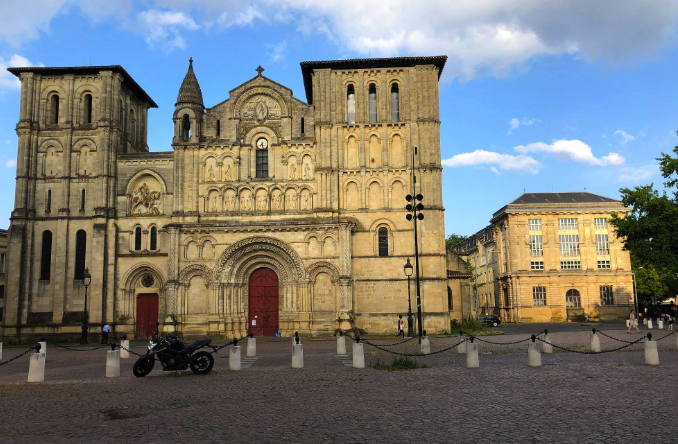
The Church of Sainte-Croix in Bordeaux, with the former Abbey to its right. Photo by Fr. Jason Vidrine
The Children of Pierre de Védrines
Jean Baptiste Lapaise de Védrines’ oldest brother, Pierre de Védrines (1707-1773), who remained in France, married Marie Pinsan (1714-1807). They had a number of children, three of which became Religious Sisters (or Nuns): Marie de Védrines (1738-1803), Catherine de Védrines (1742-1793), and Marie-Anne de Védrines (1747-1814). In her book, Védrines-Vidrine: Our Vedrines in France 1600-1750, Jacky Vidrine noted that these three daughters were living with their brother, Jean Baptiste De Védrines (1737-1813) who had never married at the Chateau Doisy-Védrines near Barsac, France. She wrote: “He must have enjoyed being fussed over by the three unmarried sisters living with him.”[9]
In fact, we know from letters that Jean Baptiste De Védrines wrote from the Chateau Doisy-Védrines, which he inherited from his father, to his neighbor at the Chateau Climens, Jean Baptiste de Monsalut, that he had sought a young woman for marriage, but was unsuccessful due to his military service.[10]
We also know from records that the sisters living with him had not simply never married like their brother, but had become Religious Sisters; and that they had all been expelled from their Convents when the Revolutionary Government abolished Monastic and Religious vows in the autumn of 1789 shortly after the beginning of the French Revolution. By the following year, on February 13, 1790, all Religious Orders were dissolved and all Monks and Nuns within them were forced to return to “private life.”[11] Marie, Catherine, and Marie-Anne did so with their brother at the Chateau Doisy-Védrines, which had become their family home.
We know that Marie de Védrines (1738-1803), the third niece of Jean Baptiste Lapaise de Védrines who was a Religious Sister was living with her brother and sisters at the Chateau Doisy-Védrines near Barsac, France in 1797, which she had moved to after the start of the French Revolution in 1789. A newsletter in Barsac a few years ago contained this information:
“We find the trace of one of his [Jean Baptiste] sisters, Marie, who needed a certificate of residence in January 1797 (19 Nivô se year V). To establish it, she had to appear before the municipal administration with three witnesses. Judging by this document, she lived in her house in the Pinesse since 1789, and, at least until 1797, the date by which the document had been prepared. The three witnesses were, Jean Sargos, merchant, Pierre Gassies, farmer, and Bernard Haché, merchant (in most cases, the witnesses were taken from among relatives or members of the commune). Marie Védrines (we are in 1790) was 58 years old, and is described thus: “Height of 5 feet, brown hair and eyebrows, blue eyes, well-made nose, round front, average mouth, short chin and round face.” This is the information which was accepted on a document, probably a passport presented to the city by Pierre Dubosq proxy holder gunsmith officer thereof.”[12]
Her sister, Marie-Anne de Védrines (1747-1814) and her fellow Religious Sisters in the Ursuline Convent in Langon, France were expelled on October 1, 1792.[13] She went to live with her brother Jean Baptiste de Védrines and fellow sisters at the Chateau Doisy-Védrines near Barsac, France shortly after. Marie-Anne was the last to live at the Chateau Doisy-Védrines. When she died on October 4 1814, her nephew, Jean Charles Michel Védrines (1796-), born in Saint-Domingue, inherited the Chateau. He was young when her inherited it and is the last member of the family to own it.
[1] Cf. http://memoiredelivrade.canalblog.com/archives/2014/05/29/29969519.html
[2] Jacqueline Olivier Vidrine, Védrines-Vidrine: Our Védrines in France 1600-1750, (Lafayette, LA, 1981), p. 132
[3] Jacqueline Olivier Vidrine, Védrines-Vidrine: Our Védrines in France 1600-1750, (Lafayette, LA, 1981), p. 131
[4] Cf. A. Jouglar,Monographie de l’abbaye du Mas-Grenier, ou, De Saint-Pierre de la cour: diocèse de Montauban, antérieurement de Toulouse, Toulouse: Delboy, 1864, https://books.google.com/books?id=45ddAAAAcAAJ&pg=PA1&source=gbs_selected_pages&cad=3#v=onepage&q&f=false
[5] Abbaye Sainte-Croix de Bordeaux, H 645 (Registre), p. 23
[6] Archives Historiques de Departement de la Gironde, Tome XLIII, Vol. 43, la Sociéte, 1908, pp. 389-340, https://books.google.com/
[7] Inventaire-Sommaire des Archives Départementales Antérieures à 1790, Seine-et-Marne
[8] Cf. https://www.ebabx.fr
[9] Jacqueline Olivier Vidrine, Védrines-Vidrine: Our Védrines in France 1600-1750, (Lafayette, LA, 1981), p. 132
[10] Cf. Rev. Jason Vidrine, The Letters of Jean Baptiste [Preignac] De Védrines 1780 – 1802, (Ville Platte, LA, 2025)
[11] Emmet Kennedy, A Cultural History of the French Revolution, (New York, 1989), p.148
[12] Cf. Michel LaVille, Barsac Au Temps de la Carmagnole, ch. 5, quoted in “Barsac Infos” July-September, 2008, pp. 14-15, https://en.calameo.com/books/0020462922
[13] Edmond Biré, Le Clergé de France pendant la Révolution (1789-1799), (Lyons, 1901) p. 347