
The particular origin of the name Védrines is currently unknown with certainty. When discussed, it always includes the assertion of three known facts: 1) that the name emerged in the Auvergne region in France’s Massif Central; 2) that it comes from at least the early Middle Ages; 3) and that it has its roots in the Latin language before being brought into the French language. Some in France have speculated that it could come from either the Latin word Vitrina (glass-making) or Veterina (indicating a flock).[1]
However, a more fascinating theory of the origin of the name Védrines, which includes the three assertions above, is that it comes from the Latin word Veterinus and emerged within the ranks of the mighty Army of the Roman Empire.
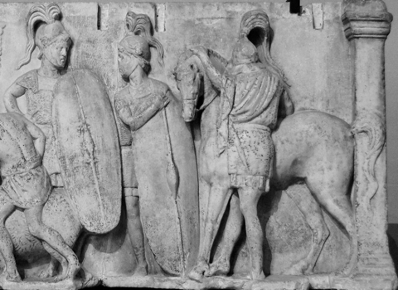
Sacrifice scene during a census: Right part of a plaque from the Altar of Domitius Ahenobarbus known as the “Census frieze”, Marble, Roman artwork of the late 2nd century BC, From the Campo Marzio, Rome.
A Veterinus was a Roman Legionary with the rank of immunis (one who had special skills and responsibilities) associated with war/draft animals and quarter mastering within the supply train of the Roman Army in its many mighty conquests.
Another closely connected immunis was the Veterinarius, who cared medically for the animals in the Roman Army. It’s the root of the English word veterinarian.
The vulgur Latin, or Latin that was spoken within the Roman Army, often included words written without the -us suffix. The evolution of the name would be: Veterinus > Veterin(e) > Vederine > Védrine. Interestingly, one of the very oldest lieux-dit (small communities) in the Auvergne is named Vederine (without the accent mark).[2] There are several other small communities that come from ancient times with the name Védrines that continue to exist in the region of Auvergne, France today.
It is still possible to visit these various small communities named Védrines in Auvergne, France. Each of them is near ancient settlements and contains very old stone structures, including homes and barns. The small “streets” in them are narrow and winding like those found in the ancient communities from the Middle Ages throughout the world. The medieval origins of these small communities can be felt.
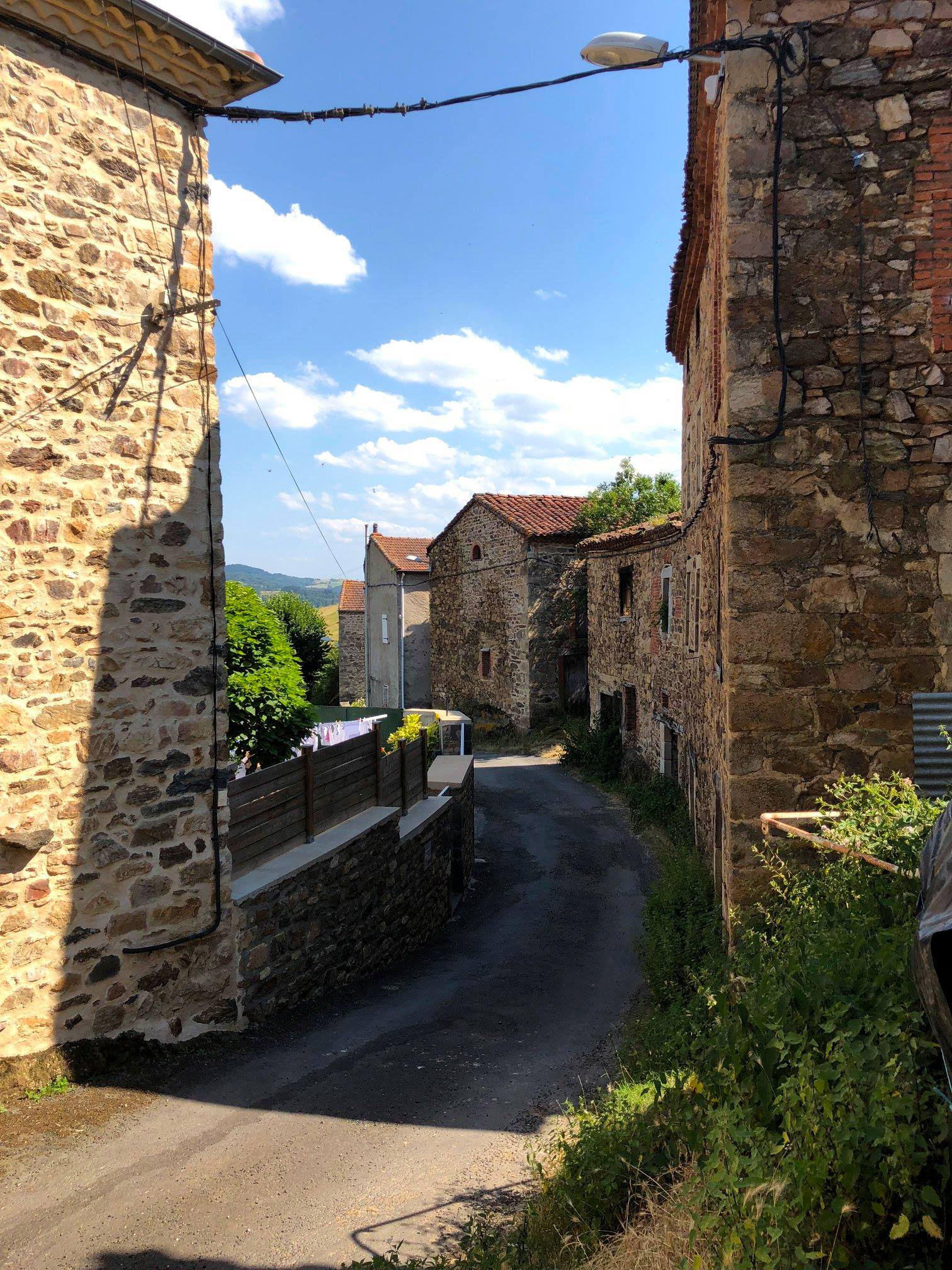
The village of Védrines near Vielle-Brioude, Auvergne, France. Photo by Fr. Jason Vidrine
What was the role of the immunis in the Roman Army, which gave rise to the Védrines name according to this theory? The historian Antony Kamm says:
“Each legion of the Roman Army had a complement of specialists and craftsmen, known collectively as immunes, ‘exempt from normal duties’: surveyors, medical and veterinary orderlies, armourers, carpenters, hunters, even soothsayers. The surveyors went ahead of the column of march to select and lay out the site of the night’s camp; it was always constructed to the same pattern and surrounded by a ditch, a rampart, and a palisade, all of which had to be built afresh each time. Leather tents, each of which slept eight men, were carried separately by mules. At legionary headquarters or in the forts that defended the empire there was a wider range of non-combatant staff, including clerks to look after and process the paperwork, paymasters, and military police.”[3]
The Roman Legionary known as a Veterinus, who was a quartermaster dedicated to the care of war/draft animals, had a very important job, and his duties were considered important enough that he was exempted from all weighty duties and provided with the position of immunis.
Within the Roman Legionary supply trains, there was a considerable number of mules. According to one approximation:
“In the 1st Century AD Roman Legionary supply trains, there were 9 Contubernium [squad of soldiers sharing a single tent] in each Century. And that means 9 tents per Century and 1 Centurion’s tent so 10. There’s no evidence where the Signifer or Optio slept. Goldsworthy says that the cramped leather (waterproof goatskin) tents used by the Contuberniums were carried by mules, which were tethered to the rear of the tent when in camp, assuming that “Marius’ Mules” carried all their personal equipment on their backs. They would probably have needed 2 real mules to carry the tent and poles for them and the Centurion and heavy equipment such as axes, pickaxes, mallets, spades, turf cutters and quern stones for grinding grain, and possibly the large caltrops (tribuli). And Cowan says that the mules were taken care of by muleteers (military slaves called Calones). I gather then that each Century would have a considerable baggage train. So let’s have a go at breaking it down here. One Century has 10 tents, carried by 18 mules based on 2 mules for each Contibernum in the care of either 9 or 18 muleteers (Calones) who were probably assigned by the Prefect Castrorum. Providing that enough animals were available, a nightmare of a job no doubt, this means that on paper one cohort of 6 Centuries would have a baggage train of 108 Mules and a similar or double number of Calones…A legion of 10 cohorts thought to number over 5,000 men, would have some 1,080 Mules and similar number of Calones coming after it. That is some supply train when you consider an army could consist of over 3 Legions, plus double that number of auxiliaries. This also bearing in mind that Marius reformed the Army so that each soldier carried more equipment on his back to cut down the amount of mules required, hence the soldiers were nicknamed with customary Latin wit, “Marius’ Mules”.”[4]
In addition to mules, the Romans also required a large number of horses to conduct their military campaigns, and this placed a heavy requirement for an effective and reliable supply of mounts for the cavalrymen. The susceptibility of horses to diseases and injuries imposed a serious demand for animal health care. “Numerous historical accounts describe the failings of a battle or military campaign due to an illness in the beasts. Polybius, describing one of the marches of Hannibal, explains how the horses had become lame, and thus unable to fight, due to heavy marching in the marshes.”[5]
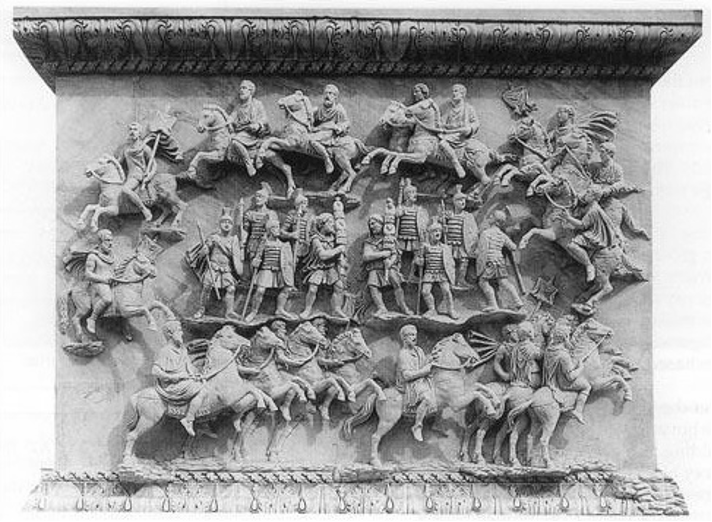
The Roman Army on the base of the column built to celebrate the achievements of Emperor Antoninus Pius.
Other important specialists within the Roman Legionary supply trains who looked after animals were the Victimarii, or “keepers of sacrificial animals”. The units of the Roman army celebrated a number of religious festivals each year. The Feriale Ouranum, a fragmentary military calendar of the early third century discovered at Dura-Europus, lists at least 26 occasions on which sacrifices were necessary, and the animals were no doubt subsequently butchered and consumed.[6]
[1] Cf. the history of the names of the communities around Alleuze, France: https://alleuze.mairie.pagespro-orange.fr/couverture/gb/textes/ch_noms.html
[2] Warren Vidrine to Fr. Jason Vidrine, February 2018.
[3] Antony Kamm, The Romans: An Introduction, Second edition (New York, 2008), pp. 174-175.
[4] Josh Provan, “How many Mules does it take…?”, 7 June 2013, https://adventuresinhistoryland.com/2013/06/07/how-many-mules-does-it-take/
[5] Lindsey Nicole Elizabeth Brill, Ubiquitous Mulomedici: The social, economic, and agronomic significance of the veterinarian to the Roman world, University of Victoria, 2009, p.36, https://dspace.library.uvic.ca/bitstream/handle/1828/3717/Brill_Lindsey_MA_2011.pdf?sequence=1&isAllowed=y
[6] Arthur Darby Nock, “The Roman Army and the Roman Religious Year.” The Harvard Theological Review 45, no. 4 (1952): 187-252. http://www.jstor.org/stable/1508393.