
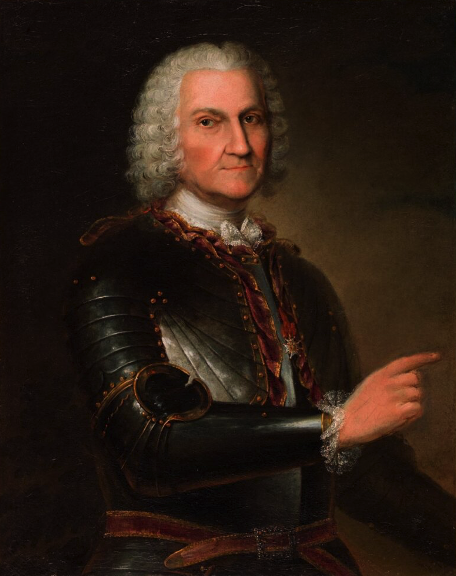
Governor Jean-Baptiste Le Moyne, Sieur de Bienville
New Orleans was founded in 1718 by Jean Baptiste LeMoyne de Bienville on the highest ground 100 miles from the mouth of the Mississippi River on its east bank and was centered around the Place d’Armes, which is now Jackson Square. He named the new settlement for Philippe II, the Duke of Orléans. A few years later, New Orleans became the capital of the French colony. Bienville’s tenure as Governor of New Orleans was a difficult one. Having resided in Louisiana for thirty-six years, Bienville finally submitted his letter of resignation to the Minister of Marine in 1742.
After several months of delay, the Royal Ship, the Charente departed Rochefort, France on January 1, 1743 with Bienville’s replacement, the Marquis Pierre de Rigaud de Vaudreuil de Cavagnial. Also aboard the Charente was Jean-Baptiste Lapaise de Védrines, a junior officer of the French Marines who was commissioned to serve the Louisiana Territory under the new Administration of Governor Vaudreuil.
They banked at La Balize, the fort at the mouth of the Mississippi River, on May 8, 1743 and arrived in the city of New Orleans a few days later, twenty-five years after the young city was founded.
Pierre de Rigaud de Vaudreuil would serve as French Governor of Louisiana from 1743 until 1753.
Having arrived with Governor Vaudreuil in New Orleans, it was under him that Jean-Baptiste Lapaise de Védrines would serve as a cadet à l’aiguillette in the garrison of French Marines stationed in the city. These were years of waiting to be commissioned as a higher officer, as David McDonald explains:
Virtually every company contained one or more cadets, who were young men in training to become officers. Cadets served in the ranks with common soldiers, though they were marked out from the first for eventual promotion. Bright, ambitious cadets might be assigned to study engeineering. The higher the status of the cadet’s family or the greater the influence of an official willing to intervene on his behalf, the shorter the time the cadet was likely to spend before commissioning, provided there was a vacancy to fill. A cadet might serve only a few months before promotion or more than a decade. The usual term was about three to six years. There were two types of cadets. The cadet de l’aiguillette was so called because he wore an aiguillette, a shoulder cord [fig. 1]. Cadets de l’aiguillette, also refered to as “gentlemen cadets,” were of higher social status and usually receive earlier promotion than the cadets of lesser status, who were designated simply as cadet soldats. Cadets were frequently sons of officers.[1]
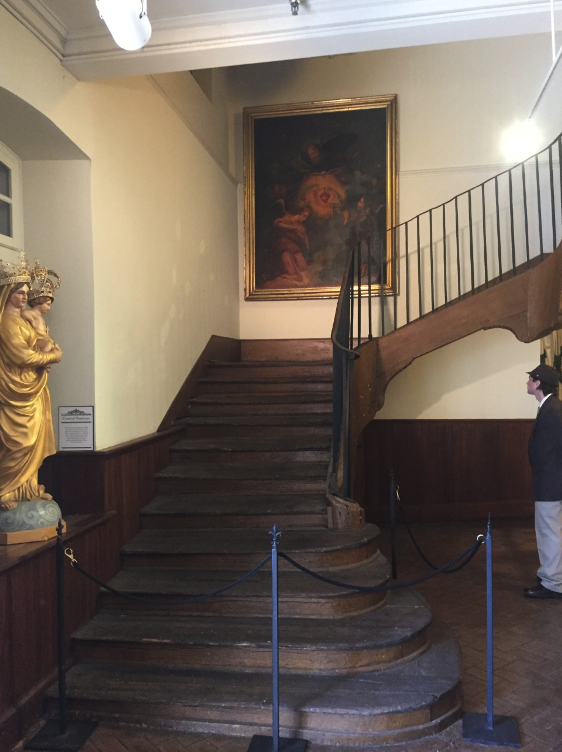
Staircase in the old Ursuline Convent built by French Marines, photo by Fr. Jason Vidrine
We know that the French Marines were given command of rebuilding the Convent for the Ursuline Nuns in 1745, which they completed in 1752. Jean-Baptiste Lapaise de Védrines was in New Olreans during these years, but we do not know if or how he might have been involved with that project. The staircase that was built in those years continues to exist in the Convent today. In fact, the old Ursuline Convent is the oldest surviving building from the French colonial period in the city of New Orleans and throughout the United States.
Jean-Baptiste Lapaise de Védrines was in Illinois by July 1751, so he most likely departed New Orleans the spring of 1751 in the special convoy that headed up the Mississippi that year.[3] Chevalier Jean Jacques MaCarty Mactigue departed New Orleans in the fall convoy and arrived as the Commandant of Fort Chartres later that year in December of 1751.
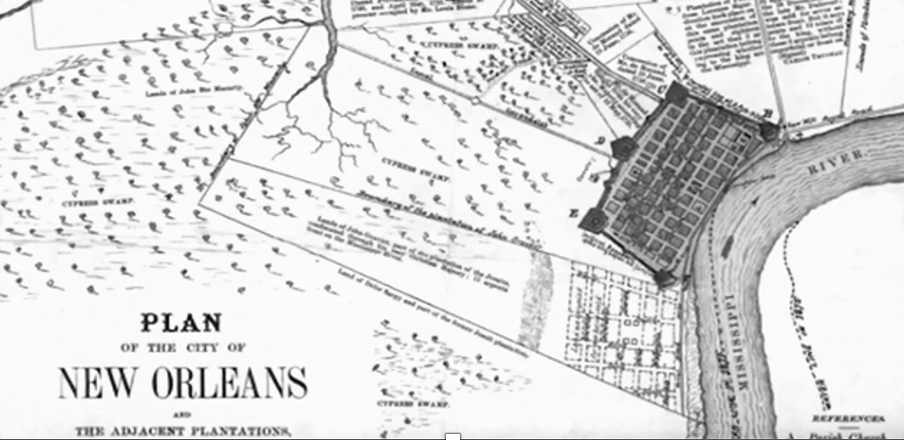
Detail of Plan of the City of New Orleans and adjacent plantations by Charles Laveau Trudeau and Alexander Debrunner, S.L.: S.N, 1875
This is an interesting description of the city of New Orleans by a French Marine, Jean-Benard Bossu (1720-1792), who arrived in New Orleans about the same time Jean-Baptiste Lapaise de Védrines was leaving. It gives an indication of the life of the city twenty-five years after it was founded, as it was when Jean-Baptiste Lapaise de Védrines arrived and during the years he lived there:
The city of New Orleans is situated on the banks of the Mississippi, one of the greatest rivers of the world, since it flows through more than twenty-four hundred miles of known country. Its pure and delicious waters serve a country of a hundred and twenty miles, in the middle of which are a number of homes which present a delightful spectacle on both banks. The owners of these homes enjoy in abundance all the pleasures of the chase, of fishing, and of all the other delicacies of life.
In New Orleans the streets are well arranged and today this city is greater and more thickly populated than it has ever been. Its inhabitants are of four sorts, Europeans, Americans, Africans or negroes, and Mongrels. The Mongrels are those who were born of Europeans and of those natives of the country whom we call savages.
They describe Creoles as those who were born of a Frenchman and a Frenchwoman, or a Frenchman and a European.
The Creoles are in general very brave, grand, and haughty. They are disposed towards the cultivation of the arts and sciences, but as they do not have the opportunity of following the teachings of good masters here, the rich and well-meaning parents do not hesitate to send their children to France as the first school of everything in the world. They do this particularly in order that the respective sexes might properly learn their positions in the world.
New Orleans and Mobile are the only cities where they do not speak in patois. Here the French that is spoken is correct. The negroes are brought from Africa. They are used in cultivating the soil, which is excellent for the cultivation of indigo, tobacco, rice, maize, and of sic sugar cane, for all of which there are very well managed plantations.
The Capuchins were the first priests to arrive in New Orleans. They came as missionaries in 1723. Their superior was the first Curé of the Parish, and these good religious devoted themselves solely to the affairs of their ministry.
The Jesuits, two years later, established themselves in Louisiana; these splendid diplomats discovered the secret of exploiting the rich land of the colony, which they obtained through their political moves.
The Ursulines came about the same time as the Jesuits, or a little later. These pious women, whose zeal is assuredly most praiseworthy, devoted themselves to the education of the young girls. They also received the orphans into their community, and for this service the King gave them a pension of fifty crowns for each orphan. They were also in charge of the military hospital.
When the colony was established, a tribe known as the Chitimachas lived on a stream to the west of New Orleans, which bore their name.”[4]
[1] David MacDonald, Lives of Fort de Chartres: Commandants, Soldiers, and Civilians in French Illinois, 1720–1770 (Carbondale, IL, 2016) p.21.
[2] Archives Nationales Coloniales, C13 A35 f. 143
[3] Archives Nationales Coloniales, C13 A34 f. 277
[4] Jean Bernard Bossu, Travels through that part of North America formerly called Louisiana, 1751-1762, (Norman OK, 1962) pp.194-195.